Future Skills Unlocked
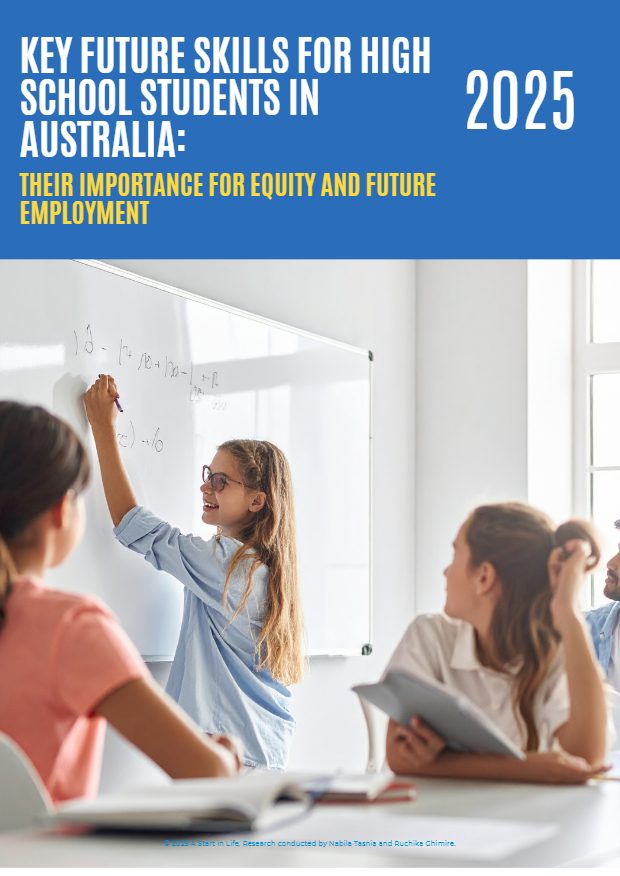
Key future skills for Australian high school students, and why they matter for equity and employment
AI fluency, emotional intelligence and adaptability are fast becoming as important as grades. This research tests whether the skills A Start in Life identified in 2022 still prepare disadvantaged students for a changing job market.
Research by Nabila Tasnia and Ruchika Ghimire, Master of Social Work (Qualifying), Excelsia University College, on placement with A Start in Life.
Everything below comes from the 16-page report, written out here so it reads well on a phone and works with screen readers and search.
In this report
Why this research
Do the skills we named in 2022 still hold up?
In 2022, A Start in Life commissioned Project Nascent to identify the skills high school students most need to enter the modern workforce. It grouped them into learning skills and behavioural skills, and made the case that students from financially disadvantaged families need these skills most urgently to keep pace with a changing economy.
Three years on, two Master of Social Work students on placement with us set out to test that work against the latest evidence. They asked two questions: what are the most essential skills high school students need to enter and stay competitive in the workforce, and are Project Nascent's findings still relevant in 2025?
The question matters because, despite policies promoting inclusion, educational outcomes in Australia remain strongly tied to socio-economic background. Students from disadvantaged communities have less access to higher education, employment pathways and the chance to build these skills in the first place.
The research at a glance
- of current core skills expected to be disrupted by 2030 (World Economic Forum, 2025)
- 39%
- publications searched, narrowed to 15 highly relevant sources
- 15,000+
- skills in the Project Nascent framework, across two categories
- 10
- new focus areas the report recommends adding
- 5
Source: Key Future Skills for High School Students in Australia, A Start in Life, 2025.
The Project Nascent skills framework
The 2022 framework this report tested, and found still holds.
Learning skills
- Creativity
- Collaboration
- Communication
- Information literacy
- Critical thinking
- Problem solving
- Digital literacy
Behavioural skills
- Social and cross-cultural skills
- Flexibility and adaptability
- Leadership
Future skills and equity
Why future skills are an equity issue
The report finds that future skills matter for far more than employability. They shape a young person's development and wellbeing, and they are not shared evenly. OECD research shows that social and emotional skills such as resilience and empathy predict long-term outcomes, yet students from lower socio-economic backgrounds are less likely to have had the chance to build them.
That makes skill development a deliberate equity strategy. Maker and Bahar (2024) found that every student, whatever their background, benefits from the chance to build creativity, collaboration and communication. Nycum and Mullen (2024) point to adaptability and digital literacy as the skills that keep young people from being shut out of the labour market.
Communities cannot afford to lose the talents of any young people.Maker and Bahar, 2024
Labour market and future employment
Work is changing faster than schools
Automation, artificial intelligence and the green and digital transitions are reshaping jobs worldwide. The World Economic Forum's Future of Jobs Report 2025 predicts that 39% of today's core skills will be disrupted by 2030, with employers putting analytical thinking, resilience, leadership and creativity at the top of their lists.
In Australia, Jobs and Skills Australia (2024) names problem solving, collaboration and adaptability as critical across growth industries including the digital economy, the care sector and renewable energy. The OECD adds that while automation takes over routine tasks, human capabilities like problem solving, empathy and adaptability cannot be automated, which puts them at the centre of employability.
Creativity, critical thinking and human-centred capabilities
The skills machines cannot replace
Creativity and critical thinking come through again and again as core skills for the future. Park and colleagues (2021) found the two reinforce each other and help people work through uncertainty. The OECD (2024) adds that curiosity and persistence lift engagement and outcomes when paired with critical thinking.
Deloitte's Global Human Capital Trends 2025 names creativity, adaptability and empathy as the human skills that complement technology. Taken together, the literature points to these human-centred capabilities as the most enduring and valuable skills a student can build.
Is Project Nascent still relevant?
Yes, but the emphasis has shifted
Across the literature there is strong agreement on the "4Cs": critical thinking, creativity, collaboration and communication, supported by adaptability, resilience, sustainability and digital literacy. Project Nascent and the OECD lean towards equity and social and emotional development, while the World Economic Forum and Deloitte focus on what industry needs.
The report concludes that the skills A Start in Life identified in Project Nascent in 2022 remain highly relevant in 2025. What has changed is their weight. Digital literacy, working with AI, resilience, emotional intelligence, sustainability and lifelong learning have all moved closer to the centre.
Five areas to add to the framework
The report recommends Project Nascent explicitly integrate these areas, so our skill development programs stay relevant for students navigating an AI-driven economy.
Resilience and emotional intelligence
Building students' capacity to manage disruption and form healthy, adaptive relationships.
OECD 2024; Deloitte 2025
Green transition and sustainability
Preparing students to work in low-carbon industries and take up sustainable practices.
OECD and European Commission 2025
Digital literacy and AI fluency
Helping students evaluate, navigate and use AI systems responsibly.
OECD and European Commission 2025
Human and AI collaboration
Equipping students to work productively alongside AI tools, using ethical judgement and creativity.
Akinnagbe 2024; Deloitte 2025
A lifelong learning mindset
Building in continuous upskilling so students stay adaptable as industries change.
McKinsey and Company 2025
From research to practice
Where these skills show up in our programs
The report concludes that by integrating these areas, A Start in Life can further strengthen its skill development programs, ensuring they remain relevant, engaging and transformative for students navigating an AI-driven economy. It also notes that the research supports organisations like ours in designing programs that prepare students for both social participation and economic opportunity.
These stories from our students show some of these skills in action.
About the researchers
Nabila Tasnia and Ruchika Ghimire completed this research during their Master of Social Work (Qualifying) placement with A Start in Life, through Excelsia University College. The project was supervised by Brianna Ott, our Student Assistance Program Manager, with the support of CEO Kathleen Donohoe and the A Start in Life team.
References
- Akinnagbe, O. (2024). Human-AI collaboration: Enhancing productivity and decision-making. International Journal of Education, Management, and Technology, 2(3), 387-417. www.researchgate.net
- Deloitte. (2025a). Tech trends 2025. Deloitte Insights. www.deloitte.com
- Deloitte. (2025b). Global human capital trends. Deloitte Insights. www.deloitte.com
- Jobs and Skills Australia. (2024). Better together: The jobs and skills report 2024. www.jobsandskills.gov.au
- Maker, J., & Bahar, K. (2024). Talent development in inclusive classrooms: An analysis of student growth. Australasian Journal of Gifted Education, 33(2), 28-56.
- McKinsey & Company. (2025). We're all techies now: Digital skill building for the future. www.mckinsey.com
- Nycum, J. F., & Mullen, C. A. (2024). Preparing high school youth for 21st-century success. VASCD Journal. www.researchgate.net
- OECD & European Commission. (2025). Empowering learners for the age of AI: An AI literacy framework for primary and secondary education (Review draft). OECD, Paris. ailiteracyframework.org
- OECD. (2019). Future of education and skills 2030: OECD learning compass 2030, a series of concept notes. OECD Publishing. www.oecd.org
- OECD. (2022). What skills and abilities can automation technologies replicate and what does it mean for workers? OECD Publishing. doi.org
- OECD. (2024). Social and emotional skills for better lives: Findings from the OECD survey on social and emotional skills 2023. OECD Publishing. doi.org
- OECD. (2025). Education at a Glance 2025: OECD Indicators. OECD Publishing, Paris. doi.org
- Park, J. H., Niu, W., Cheng, L., & Allen, H. (2021). Fostering creativity and critical thinking in college: A cross-cultural investigation. Frontiers in Psychology, 12. doi.org
- Project Nascent. (2022). Project Nascent Skills V2. A Start in Life.
- World Economic Forum. (2025). Future of jobs report 2025. www.weforum.org
© 2025 A Start in Life. Research conducted by Nabila Tasnia and Ruchika Ghimire.
Help a student build the skills the future will ask of them
A gift today funds tutoring, career coaching and the skills programs that help a student from a family doing it tough stay at school and step into work with confidence.
15 January 2026